
CAT 2025 Question Paper | DILR Slot 1
CAT Previous Year Paper | CAT DILR Questions | Question 4
 CAT Questions
 CAT 2025 DILR was similar to CAT 2022 in pattern. All the four sets had 5 questions this year too. There were 6 TITA Questions. Atleast two sets were doable in each slot and one of the four sets was extremely tough. Choice of Sets became a crucial factor. Overall this section was at a medium to high level of difficulty.
A train travels from Station A to Station E, passing through stations B, C, and
D, in that order. The train has a seating capacity of 200. A ticket may be booked from any
station to any other station ahead on the route, but not to any earlier station.
A
ticket from one station to another reserves one seat on every intermediate segment of the route.
For example, a ticket from B to E reserves a seat in the intermediate segments B – C, C
– D, and D – E.
The occupancy factor for a segment is the total number of
seats reserved in the segment as a percentage of the seating capacity. The total number of seats
reserved for any segment cannot exceed 200.
The following information is
known.
1. Segment C – D had an occupancy factor of 95%. Only segment B – C had
a higher occupancy factor.
2. Exactly 40 tickets were booked from B to C and 30 tickets
were booked from B to E.
3. Among the seats reserved on segment D – E, exactly
four-sevenths were from stations before C.
4. The number of tickets booked from A to C was
equal to that booked from A to E, and it was higher than that from B to E.
5. No tickets
were booked from A to B, from B to D and from D to E.
6. The number of tickets booked for
any segment was a multiple of 10.
Question 4 : What is the difference between the number of tickets booked to Station C and the number of tickets booked to Station D?
Best CAT Online Coaching
Try upto 40 hours for free
Learn from the
best!
2IIM : Best Online CAT Coaching.
Video Explanation
Best CAT Coaching in Chennai
CAT Coaching in Chennai - CAT 2022
Limited Seats Available - Register Now!
Explanatory Answer
A train travels A → B → C → D → E and has 200 seats.
A ticket reserves one seat on every segment between its origin and destination.
The key is to translate ticket bookings into segment occupancies, because the same ticket can contribute to several segments.
Let's follow the convention that P→Q is the number of tickets booked at station P with station Q being the destination.
A→C = A→E = a,
A→D = b, C→D = x, and C→E = y.
We are given B→C = 40, B→E = 30, while A→B = B→D = D→E = 0.
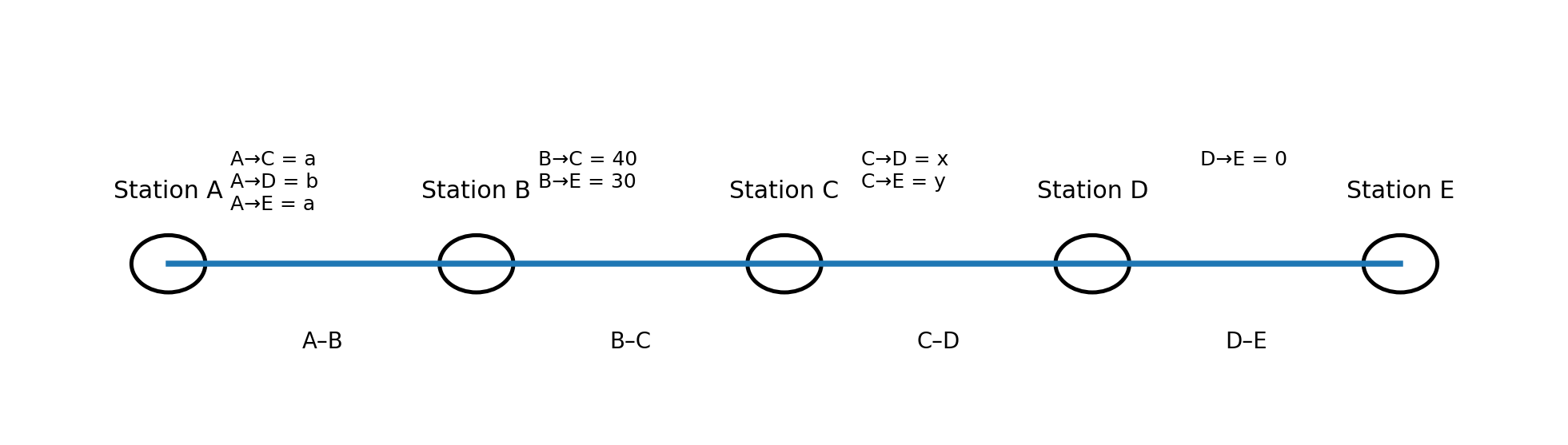
Segment C–D has 95% occupancy, so it has 190 seats reserved. The only segment with a higher occupancy is B–C.
Since every segment count is a multiple of 10 and capacity is 200, B–C must therefore have exactly 200 seats.
On B–C, the passengers are those holding A→C, A→D, A→E, B→C and B→E tickets.
Hence a + b + a + 40 + 30 = 200
2a + b = 130. (1)
On D–E, only A→E, B→E and C→E tickets contribute. Thus D–E occupancy is a + 30 + y
The passengers who boarded before C are those from A and B, namely A→C and B→C, they add up to (a + 30). This is four-sevenths of the D–E occupancy:
a+30 = (4/7)(a+y+30).
a+y+30 = (7/4)(a+30).
Because segment counts are multiples of 10 and a > 30, the possible values consistent with (1) lead to a = 50.
Hence 50+y+30 = (7/4)(50+30) = 140, so y = 60.
For C–D, the occupancy is 190:
50 + b + 20 + 60 + 30 = 190.
Thus b = 30 and then from (1), x = 20.
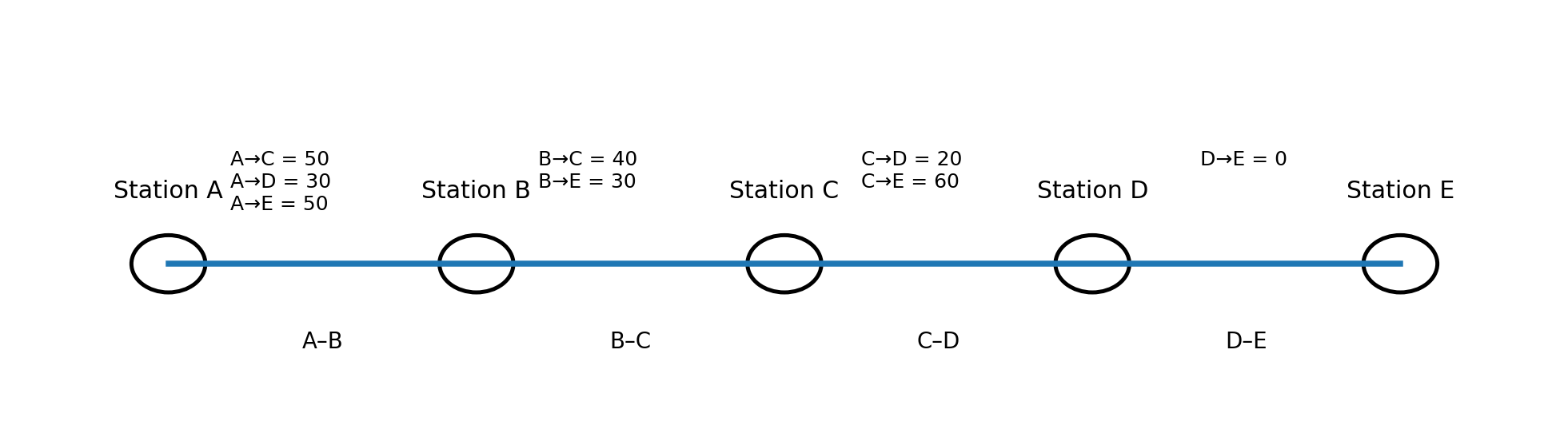
Difference between tickets booked to C and to D
Tickets to C = A→C + B→C = 50+40 = 90. Tickets to D = A→D + B→D + C→D = 30+0+20 = 50.
Difference: 40.
The question is " What is the difference between the number of tickets booked to Station C and the number of tickets booked to Station D? "
Hence, the answer is '40'